On Sept 29, the Department of Land Use Services released an amended version of the San Bernardino County mining ordinance revision. See our response here.
Category Archives: Updates
Best way to defeat the Music Valley Mine?
Stay informed by signing up for the Protect Music Valley email list!
County Land Use Services Responds
San Bernardino County Land Use Services issued the below email this afternoon in response to letters and comments from the community regarding the proposed revision of the County’s Mining Ordinance (Chapter 88.03). We have posted the attachments that were included, the Final Draft with changes and the Final Mining Ordinance FAQ. We are reviewing the materials and consulting with knowledgeable allies and will provide our take once we have sorted through the still confusing language. In the meantime, thank you everyone who has sent in comments!
Dear Community Members,
Thank you for sharing your comments on the proposed revisions to San Bernardino County’s Mining Ordinance (Chapter 88.03) presented to the Board of Supervisors and considered on August 18, 2026.
We appreciate the questions and concerns raised by the community members and organizations who took the time to share them. We understand some of the proposed changes, especially those related to mining operations on federal lands, have raised questions about the County’s permitting authority, opportunities for public input, environmental review, and local oversight. The County recognizes the importance of addressing these issues clearly and providing more opportunities for public understanding and feedback.
The Board of Supervisors continued the item from August 18 to the October 20, 2026 Board meeting for reconsideration. Ahead of that hearing, the Land Use Services Department, together with the County’s legal staff, has reviewed all comments and prepared the attached Frequently Asked Questions as a public outreach document to provide further clarification.
We have attached the draft ordinance for your review as well. All proposed changes are shown in red to clearly identify proposed revisions to the ordinance. The proposed revisions are intended to take into consideration the feedback and suggestions received from community members and organizations, including the comments shared by those in attendance during the public hearing portion of the August 18 Board meeting.
We encourage you to review these materials and share any additional questions or comments. Feedback may be sent to miningreclamation@lus.sbcounty.gov. Any comments submitted before the hearing will also be added to the public record for the Board’s consideration.
Our goal is to ensure residents, community organizations, and other stakeholders have the information they need to understand the proposed revisions and continue participating in the public process before the item returns to the Board.
Thank you again for your continued interest and involvement.
Community Meeting Tuesday Oct 6
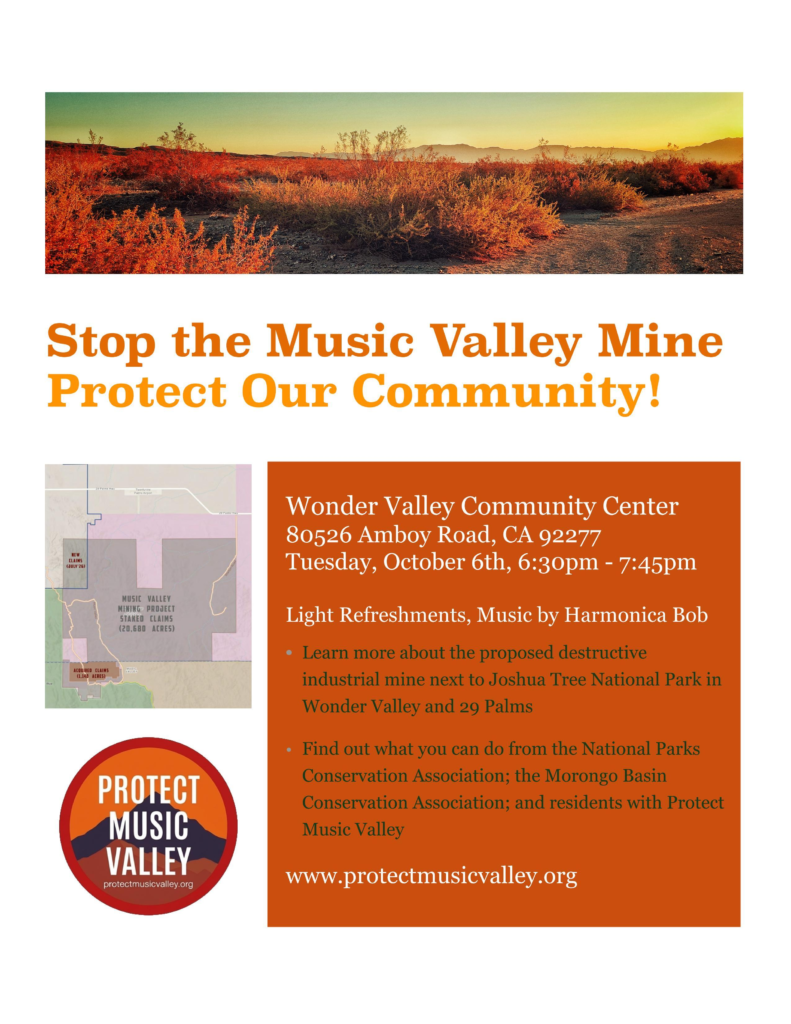
It’s official! Protect Music Valley will host a community informational meeting about the Music Valley Mine on Tuesday Oct 6 at the Wonder Valley Community Center. Attendees will learn more about the proposed destructive industrial-scale mine next to Joshua Tree National Park, in Wonder Valley and 29 Palms. Find out what you can do from the National Parks Conservation Association, the Morongo Basin Conservation Association, and residents with Protect Music Valley. Light refreshments, and music by Harmonica Bob! All welcome. Help spread the word with a printable flyer. Tuesday Oct 6, 6:30-7:45 pm. Wonder Valley Community Center, 80526 Amboy Road.
Attention: If you signed up for our email list…
Due to a technical problem in setting up our email sign-up form, your submission of your name and email address, to be added to our email list, may not have succeeded.
If you attempted to sign up via the form – on the right-hand side of our web pages – over the past few days, September 9, 10 or 11, please enter your information again. When you do, you should receive a confirmation email message that you should respond to that will complete your sign-up, or a message on the website, that you have already signed up.
If you have any questions on this please Contact Us.
We apologize for this problem.
Revision of the County Mining Ordinance Could Open the Gate to the Music Valley Mine
The County of San Bernardino should be the first line of defense for desert residents if the Music Valley Mine project proceeds. However, the County has proposed to repeal and reenact Chapter 88.03 of the County Development Code, their ordinance regulating mining, and this could leave residents out of the process. Therefore, we are opposed to the proposal as currently written.
Let’s get into why. And if it seems confusing, you’re not alone! We’re still learning about it ourselves. As our understanding improves we’ll update, but this is how we understand it at the moment.
Specifically, we oppose the addition of a new section, 88.03.040 (b). (You can read the full section at the bottom of this post.)
Two parts of this new section are concerning. To quote:
- ….. the County may accept documents and environmental studies prepared by federal agencies as functionally equivalent to meet the County’s requirements…
- A Permit shall not be required for those portions of surface mining operations that require and obtain a federally approved plan of operation, or other federal authorization… [emphases added]
So what’s the problem here? By referring to “permits” broadly, the proposed ordinance risks allowing new mining projects to bypass California’s strong protections under the Surface Mining and Reclamation Act (SMARA) and California Environmental Quality Act (CEQA). This means the public could be completely left out of the process as there would be no opportunity for public comment as required by CEQA. A mining company could simply obtain federal permits and complete a much weaker National Environmental Policy Act (NEPA) review and start mining, without ever talking to the County or starting the SMARA / CEQA process because the ordinance says no county permit is required on federal lands. (If you want to get deeper into the weeds, see this joint comment letter to the County from National Parks Conservation Association, Earthworks, Mojave Desert Land Trust, and Center for Biological Diversity.)
In essence, if this added section 88.03.040 (b) is passed, the County could give up the local stewardship of these public lands and allow Washington, DC to make decisions that affect the residents of San Bernardino County. These “federal” decisions could especially impact the quality of life for the county’s rural residents. For example, with Dateline’s proposed Music Valley mine, the residents of Wonder Valley could have to live with the toxic dust, noise, and possible water pollution in an area where residents depend on domestic wells.
The County Board of Supervisors heard this proposal on August 18 and, after listening to desert residents including folks from Protect Music Valley, decided to continue the hearing until Oct 20. The language and reasoning of the proposal is confusing, and the Board was not satisfied that the Land Use Services Department (LUS) had communicated the ordinance changes adequately. Specifically, the Board directed LUS to “conduct additional community outreach, respond to questions from the community and evaluate potential clarifying amendments before the item returns for further consideration.”
Protect Music Valley is now reaching out to Land Use Services to see that our community is included in the process going forward. The residents of San Bernardino County need to know definitively the answers to these questions:
- If this ordinance passes, will any mining operation or portion of an operation that currently goes through County permitting, CEQA review, public notice, public hearings, or County-imposed conditions no longer go through those processes because of the new federal-land provision – yes or no?
- Specifically, is there any County or public oversight that exists under the current ordinance that would no longer exist or would be diminished under the proposed ordinance – yes or no?
- If the answer to question #2 is no, please explain to Wonder Valley residents why the new “Permit shall not be required” language is being added. The current ordinance does not specifically state that a County permit “shall not be required” for federally authorized mining. If the County truly has never had permitting authority in these circumstances, why is this new exemption necessary?
Our Board of Supervisors have been entrusted to protect our community assets, to protect our lands, and to protect the way of life of the residents who choose to live in these beautiful and peaceful rural areas. As the voice of the residents, we need our County Board of Supervisors to represent our interests. The Board must remain part of the discussion and permitting process for all industrial mines.
What happens next? The Board will need to hear from county residents on this issue at the County hearing on October 20th. Please mark your calendars and plan to attend, either in person or via remote online connection, and we will have more opportunities for action coming up. If you’re not already on our mailing list, please sign up in the sidebar to remain informed.
~ ~ ~ ~ ~ ~ ~ ~ ~ ~ ~ ~ ~ ~ ~
For reference: the actual language of ordinance 88.03.040 (b) addition is as follows:
(b) Federal Lands. Where surface mining operations occur, or are proposed, partially or entirely on federally managed public lands, the County may accept documents and environmental studies prepared by federal agencies as functionally equivalent to meet the County’s requirements under this Chapter, consistent with the 1992 Memorandum of Understanding between the State of California and such federal agencies, and any subsequent amendments or successor agreements entered into by the parties. A Permit shall not be required for those portions of surface mining operations that require and obtain a federally approved plan of operation, or other federal authorization, to conduct surface mining operation.
Show up at the 29 Palms City Council meeting on Tuesday!
The City of Twentynine Palms can play an important role in the fight against the Music Valley Mine. The National Parks Conservation Association (NPCA) will be giving a brief presentation on the issue at the City Council Meeting on Tuesday, Sept 8 at 6 pm, and residents are encouraged to be there to comment with your concerns.
NPCA believes the City Council needs to hear from their constituents especially on economic impacts and neighborhood/road impact, particularly in the Hanson Tract. They encourage commenters to be courteous, respectful, and brief.
See you on Tuesday at 6136 Adobe Road, Twentynine Palms, CA 92277. And please tell your friends!
Why Protect Music Valley?
by Beth
Mining, although a necessary function, is a messy business.
The Australian mining company named Dateline Resources has staked close to 1,000 mining claims across 20,000 acres (roughly 31 square miles) near the Twentynine Palms entrance to Joshua Tree National Park and our community of Wonder Valley. The claim area includes claims staked within the city limits of Twentynine Palms.
Dateline Resources hopes to mine for heavy rare earth elements, which are used in the manufacture of electric vehicles, cell phones and other electronics, wind turbines and military equipment.
We all use some of these items, right? So, why are we opposed to mining in Music Valley? Let me share a few initial concerns.
HOW IS MINING DONE?
Although there are no publicly available planning documents, we can guess that the mining technique that may be used for this mine will be strip mining or pit mining. These techniques begin with dynamite explosions to break up the surface of the earth. This will likely be followed by breaking down larger rocks into smaller rocks, possibly through large rock tumblers. (Learn about some mining techniques in this 10-minute video.)
Once the rock, or ore, is broken down to a manageable size, chemicals such as cyanide or sulfuric acid may be used to extract the desired element from the ore. Alternately, the ore may be transported to another location for additional processing. Much of the rare earth element processing is done in China, which is the largest processor globally for these elements. (This 10-minute video explains how metals such as gold or copper are extracted.)
Once the desired elements have been extracted, all of the remaining materials, now called “tailings“, are the “rubbish” of the mining process. As you can imagine, breaking down large rocks into smaller and smaller rocks simply to extract a few grams of a powdered substance will leave a large amount of tailings.
CONCERNS
So, how might the Music Valley mine impact our communities?
Noise and Dust: First, and likely most obvious, will be the noise and vibrations of the explosions, followed by clouds of dust. (I hope the wind is blowing that day, to carry the PM2 toxic dust away from Wonder Valley residents!) Because it is heavy rare earth elements being mined, there could be radiation particles in the dust. And, as all of the rocks and earth are moved around and loaded onto trucks for transport, the dust will continue.
Traffic and Roads: Next, we can expect the noise and lighting of the large machinery, such as earthmovers, and will notice the increased traffic of the large equipment haulers transporting the ore to the next location for processing. The weight of those trucks will accelerate the breakdown of our local roads and highways (which we, the taxpayers, pay for.) There could be flaggers directing traffic on Utah Trail or the highway, disrupting tourists on the way to the park. And, how will the increase of large truck traffic affect the pedestrian-friendly downtown area of Twentynine Palms?
Economic Impacts: Our local economy is centered around the tourism industry, with our beloved Joshua Tree National Park attracting nearly three million visitors per year, generating $218 million dollars annually to local economies and gateway communities. This mine will be visible and audible to the park visitors who enter the park using the Twentynine Palms entrance and to visitors in Wonder Valley.
Wildlife: The desert creatures are also an attraction for visitors, especially our precious desert tortoises. The Music Valley area is designated as critical habitat for these endangered creatures. Contrary to the casual attitudes of developers, who will just “get a Take Permit” to relocate the tortoises that are in their way, these animals do not adapt well to relocation. To quote a local tortoise fan and previous California Desert Program Manager, “Don’t get me started on suggestions to relocate tortoises. I liken it to taking your grandpa and dropping him off in the middle of the Mojave Desert with nothing but his shoes — completely disorienting.”
Dark Skies: Our beautiful dark skies are another feature that attract tourists to this area. However, the nighttime lighting of the work going on at the mines will detract from our beautiful dark skies, causing a constant nighttime glow. (Learn more about Dark Skies.)
Where Will the Workers Live? Can Twentynine Palms, a city already suffering housing shortages, house the additional workers who will be doing the actual mining? Will this make our city less livable / available to current residents and their families?
Water: And, most important: water. In this desert environment, water is life. In Wonder Valley, we do not have city-supplied water. We get our water from domestic wells. The aquifer that Wonder Valley taps into is called the Dale Basin, also referred to as the Dale Valley. Although there have not been studies focused specifically on Dale Basin, we can reference the studies done for our neighbors to the west, the Twentynine Palms Groundwater Management Plan. (Refer to section 4.3 of the Kennedy Jenks Study or see map here.)
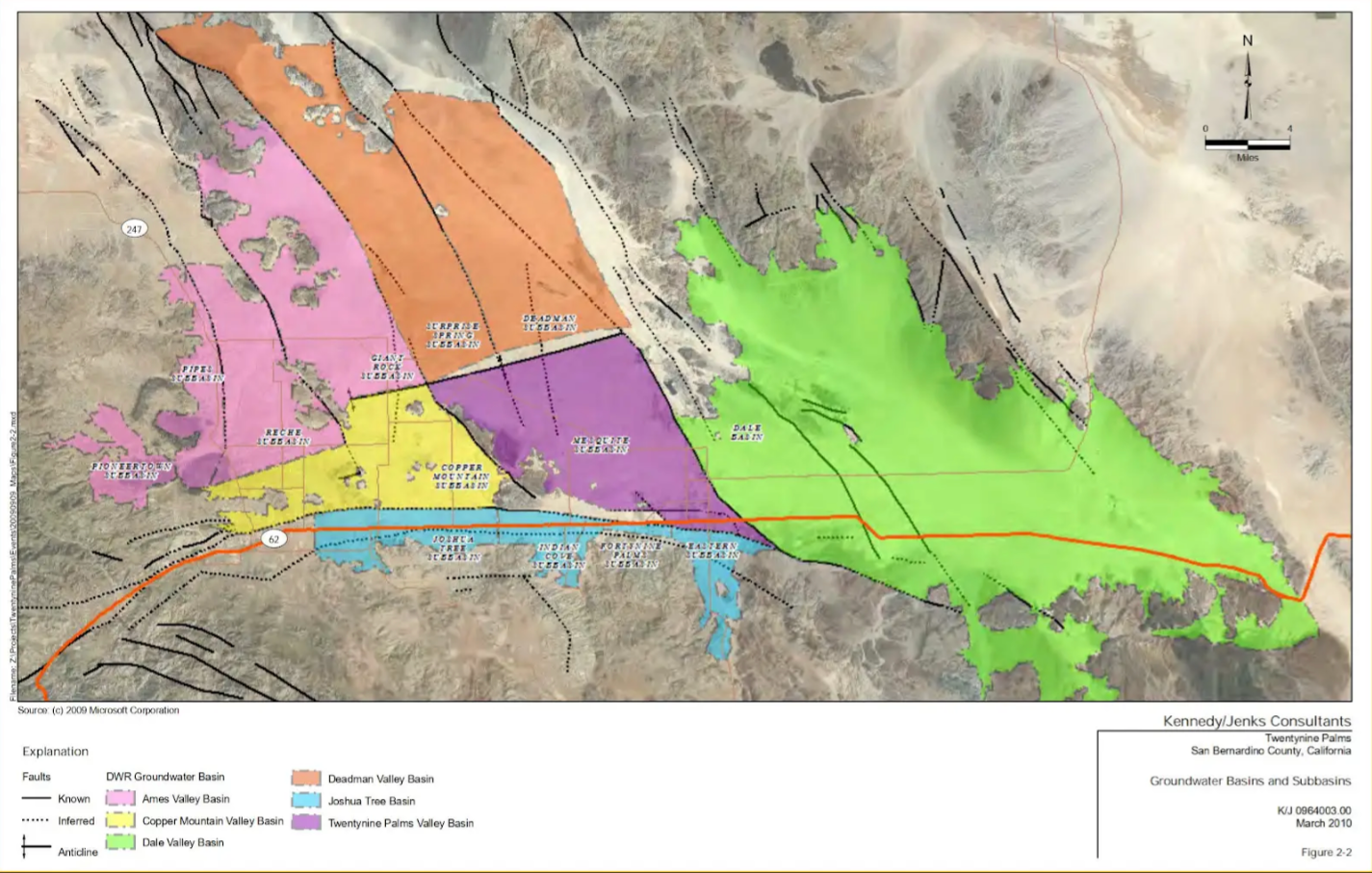
Referencing this study, it is likely that the water that recharges the aquifer under Wonder Valley is runoff from the downslopes of the Pinto Mountains. Yes, the same Pinto Mountains where the Music Valley mine claims are. Whatever Dateline Resources does up there in Music Valley could impact our water – both water quality (that is, possible pollution of our groundwater) and water quantity, as large amounts of water is used to both control dust during the excavation process and possibly to wash the ore that has been extracted.
Who Benefits??
Of note, Dateline Resources is an international company staking mining claims on U.S. soil with intention to extract the rare earth elements, and possibly some gold, which this international company will then own. What does the U.S. get out of this? What will our community get out of this? It’s not clear that we will gain anything, other than scars upon the land, possible polluted water and the cost of the clean up after the mine is closed and any “reclamations” funds run out.
These are just a few initial concerns, and more will be shared as we continue to research this issue. Please check back for updates, and find additional resources, maps, links, etc., here.