by Beth
Mining, although a necessary function, is a messy business.
The Australian mining company named Dateline Resources has staked close to 1,000 mining claims across 20,000 acres (roughly 31 square miles) near the Twentynine Palms entrance to Joshua Tree National Park and our community of Wonder Valley. The claim area includes claims staked within the city limits of Twentynine Palms.
Dateline Resources hopes to mine for heavy rare earth elements, which are used in the manufacture of electric vehicles, cell phones and other electronics, wind turbines and military equipment.
We all use some of these items, right? So, why are we opposed to mining in Music Valley? Let me share a few initial concerns.
HOW IS MINING DONE?
Although there are no publicly available planning documents, we can guess that the mining technique that may be used for this mine will be strip mining or pit mining. These techniques begin with dynamite explosions to break up the surface of the earth. This will likely be followed by breaking down larger rocks into smaller rocks, possibly through large rock tumblers. (Learn about some mining techniques in this 10-minute video.)
Once the rock, or ore, is broken down to a manageable size, chemicals such as cyanide or sulfuric acid may be used to extract the desired element from the ore. Alternately, the ore may be transported to another location for additional processing. Much of the rare earth element processing is done in China, which is the largest processor globally for these elements. (This 10-minute video explains how metals such as gold or copper are extracted.)
Once the desired elements have been extracted, all of the remaining materials, now called “tailings“, are the “rubbish” of the mining process. As you can imagine, breaking down large rocks into smaller and smaller rocks simply to extract a few grams of a powdered substance will leave a large amount of tailings.
CONCERNS
So, how might the Music Valley mine impact our communities?
Noise and Dust: First, and likely most obvious, will be the noise and vibrations of the explosions, followed by clouds of dust. (I hope the wind is blowing that day, to carry the PM2 toxic dust away from Wonder Valley residents!) Because it is heavy rare earth elements being mined, there could be radiation particles in the dust. And, as all of the rocks and earth are moved around and loaded onto trucks for transport, the dust will continue.
Traffic and Roads: Next, we can expect the noise and lighting of the large machinery, such as earthmovers, and will notice the increased traffic of the large equipment haulers transporting the ore to the next location for processing. The weight of those trucks will accelerate the breakdown of our local roads and highways (which we, the taxpayers, pay for.) There could be flaggers directing traffic on Utah Trail or the highway, disrupting tourists on the way to the park. And, how will the increase of large truck traffic affect the pedestrian-friendly downtown area of Twentynine Palms?
Economic Impacts: Our local economy is centered around the tourism industry, with our beloved Joshua Tree National Park attracting nearly three million visitors per year, generating $218 million dollars annually to local economies and gateway communities. This mine will be visible and audible to the park visitors who enter the park using the Twentynine Palms entrance and to visitors in Wonder Valley.
Wildlife: The desert creatures are also an attraction for visitors, especially our precious desert tortoises. The Music Valley area is designated as critical habitat for these endangered creatures. Contrary to the casual attitudes of developers, who will just “get a Take Permit” to relocate the tortoises that are in their way, these animals do not adapt well to relocation. To quote a local tortoise fan and previous California Desert Program Manager, “Don’t get me started on suggestions to relocate tortoises. I liken it to taking your grandpa and dropping him off in the middle of the Mojave Desert with nothing but his shoes — completely disorienting.”
Dark Skies: Our beautiful dark skies are another feature that attract tourists to this area. However, the nighttime lighting of the work going on at the mines will detract from our beautiful dark skies, causing a constant nighttime glow. (Learn more about Dark Skies.)
Where Will the Workers Live? Can Twentynine Palms, a city already suffering housing shortages, house the additional workers who will be doing the actual mining? Will this make our city less livable / available to current residents and their families?
Water: And, most important: water. In this desert environment, water is life. In Wonder Valley, we do not have city-supplied water. We get our water from domestic wells. The aquifer that Wonder Valley taps into is called the Dale Basin, also referred to as the Dale Valley. Although there have not been studies focused specifically on Dale Basin, we can reference the studies done for our neighbors to the west, the Twentynine Palms Groundwater Management Plan. (Refer to section 4.3 of the Kennedy Jenks Study or see map here.)
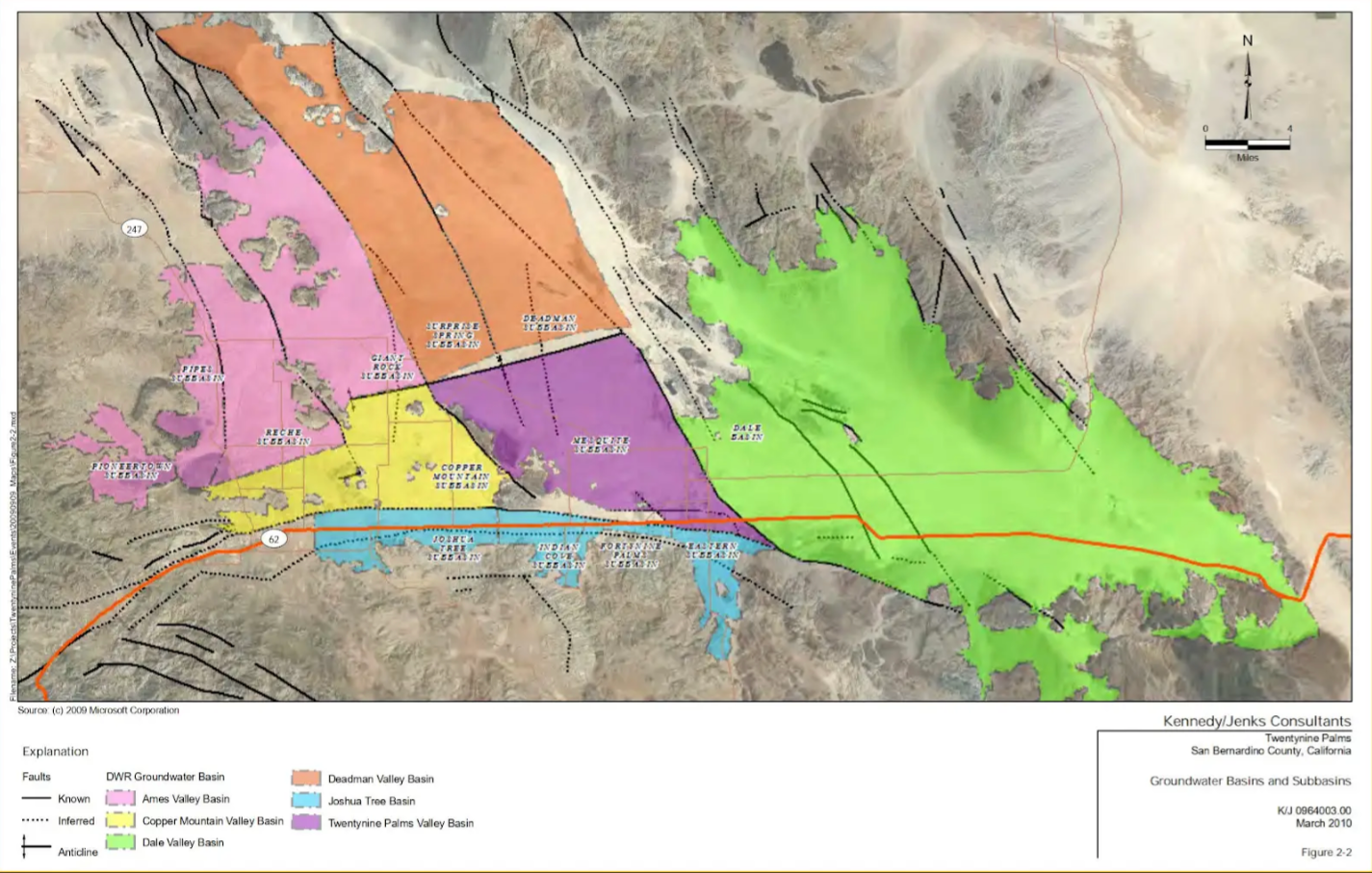
Referencing this study, it is likely that the water that recharges the aquifer under Wonder Valley is runoff from the downslopes of the Pinto Mountains. Yes, the same Pinto Mountains where the Music Valley mine claims are. Whatever Dateline Resources does up there in Music Valley could impact our water – both water quality (that is, possible pollution of our groundwater) and water quantity, as large amounts of water is used to both control dust during the excavation process and possibly to wash the ore that has been extracted.
Who Benefits??
Of note, Dateline Resources is an international company staking mining claims on U.S. soil with intention to extract the rare earth elements, and possibly some gold, which this international company will then own. What does the U.S. get out of this? What will our community get out of this? It’s not clear that we will gain anything, other than scars upon the land, possible polluted water and the cost of the clean up after the mine is closed and any “reclamations” funds run out.
These are just a few initial concerns, and more will be shared as we continue to research this issue. Please check back for updates, and find additional resources, maps, links, etc., here.