What do we know about the Music Valley Mine?
Over 20,000 acres of mining claims – 31 square miles – have been staked within Music Valley by an Australian mining company, Dateline Resources. The project would likely involve open-pit mining to search for heavy rare earth elements (HREE) used in electronics, magnets, and military equipment. Per the Dateline Resources website:
Dateline has acquired and consolidated the Music Valley Heavy Rare Earths Project, located in Riverside and San Bernardino Counties, California. The project is highly prospective for heavy rare earth mineralisation, with rock chip sampling by the United States Geological Survey (USGS) returning high grades of 6.69 – 15.04% TREO in the area, including high Yttrium and Dysprosium grades. Mineralisation is hosted in xenotime within the biotite-rich Pinto Gneiss, with a fractionated HREE signature.
At this time no permit applications or plan of operations are known to have been filed, but field mapping and rock chip and soil sampling is proceeding, according to the Dateline Resources website.
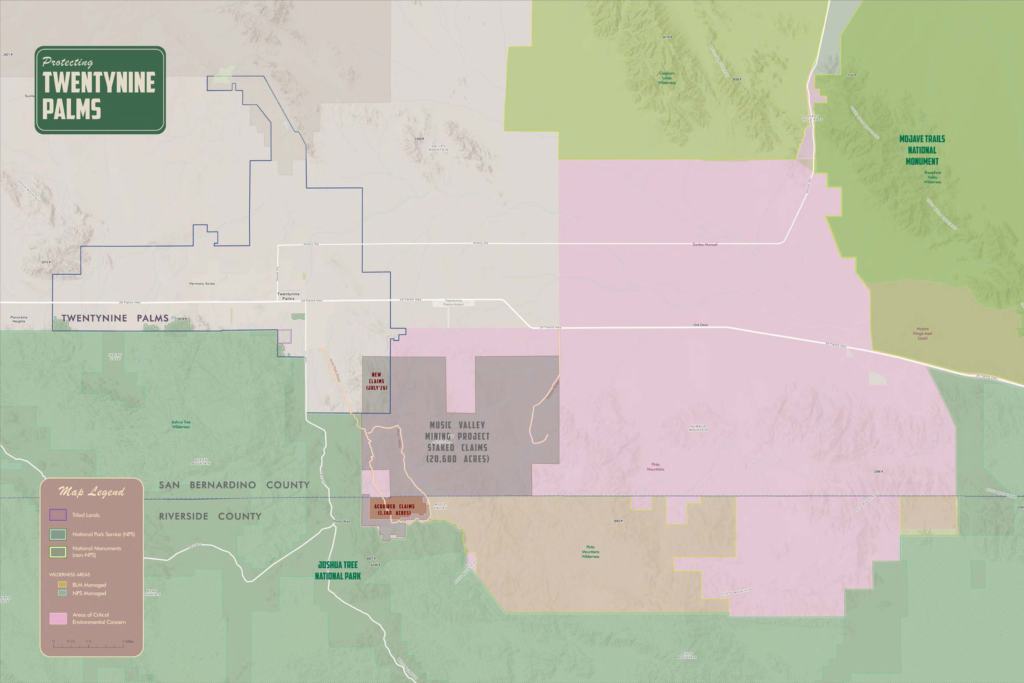
Most of the claims are on federal land owned by the citizens of the United States and managed by the Bureau of Land Management (BLM), with some claims bordering Joshua Tree National Park. The majority of the lands claimed fall within San Bernardino County with some within Riverside County, but, notably, the claims have mostly been filed in the County of Riverside. In July 2026 new claims were also filed on land within the southeast portion of the City of Twentynine Palms.
Where is the Music Valley Mine?
The mine claims overlie Music Valley and the Pinto Mountains with Joshua Tree National Park on the south, the City of Twentynine Palms on the west, and the homestead community of Wonder Valley on the north and east. The claims lie north of the Pinto Mountains Wilderness and almost wholly within the Pinto Mountains Area of Critical Environmental Concern (ACEC):
The project is located in what’s known as an area of critical environmental concern. The U.S. Fish and Wildlife Service has deemed the sweeping landscape to be crucial to the survival of the Mojave desert tortoise, which is endangered in California thanks to a stew of threats including development, disease, raven predation and climate change. The land abutting the Pinto Mountains Wilderness is also home to badgers, bighorn sheep and Mojave fringe-toed lizards. Massive yuccas and barrel cacti stud its steep slopes. – Los Angeles Times, 3/30/2026
How would the mine be accessed?
Heavy truck traffic would be part of any large-scale mining project. Music Valley is remote, and the limited access is mostly unimproved. The road most likely to serve the mine, Gold Park Road, runs directly through the Twentynine Palms Hanson Tract neighborhood. The other potential access is Shelton Road, running south from State Route 62 in Wonder Valley. A major increase in heavy truck traffic should also be expected on taxpayer-maintained city and county roads and the state highway, with attendant roadbed degradation and safety concerns.
Who is Dateline Resources?
Dateline Resources is a new-ish mining company based in Sydney, Australia. Their main asset is the Colosseum Mine inside the East Mojave National Preserve, a gold mine that was discontinued in 1993 and is now being resurrected by Dateline for both gold and light rare earth elements. Dateline’s career in the Mojave Desert so far has been concerning:
When Dateline bought Colosseum in 2021, it began bulldozing and building new roads without a valid permit from the National Park Service (NPS), according to [National Parks Conservation Association California Desert Associate Director Chance] Wilcox. The NPS ordered the company to stop and demanded more than $200,000 in damages. Wilcox said that dispute quieted down after the 2024 election, and the NPS later withdrew its permit demands as the new administration pushed to fast-track mineral production. Bulldozing at Colosseum has continued since. — The Desert Trumpet, 7/23/2026
What’s involved in mining for Heavy Rare Earth Elements (HREE)?
If this project moves forward, it would likely involve an open-pit quarry, with explosives used to blast the solid rock into manageable chunks, hauling with large excavators, loading of blasted rock into heavy haul trucks, transporting ore to a processing facility, and possibly some level of crushing and grinding where large jaw crushers and cone crushers mechanically smash boulder-sized rocks down to the size of gravel.
Rare earths mining typically involves pulling out ore with jackhammers or dynamite and grinding it down before chemically treating it — processes that consume a lot of energy, generate toxic waste and can unleash radiation that’s often present in the ore, said [Daniel O’Connor, co-founder and chief executive of Rare Earth Exchanges, a website that covers the global rare earths market.] – Los Angeles Times, 3/30/2026
There are clearly many environmental factors that come into play if industrial scale mining in Music Valley would become a reality. Focusing on the water element only, and assuming no milling on site at Music Valley, large amounts of water will already be needed for dust mitigation and heavy equipment maintenance.
What is the San Bernardino County Mining Ordinance revision?
San Bernardino County has proposed an update to its current mining ordinance. It is far from clear whether the changes in this update are even necessary under State law. Sloppy drafting in the current proposal potentially would allow mining operations on federal land like Music Valley Mine to proceed without requiring a County permit, thereby leaving residents out of a crucial part of the approval process. After the County Planning Commission recommended approval, the revision was heard by the County Board of Supervisors on August 18, 2026, where desert residents spoke in opposition to the language as proposed. The Board continued the item until October 20 and directed the Land Use Services Department to “conduct additional community outreach, respond to questions from the community and evaluate potential clarifying amendments before the item returns for further consideration.”
This page will be updated with more information as available. Find additional links, maps, and more on our Resources page.